
The vacuum roll is one of the most expensive rolls in a paper machine. Costs associated with spare roll procurement due to seal strip usage, production losses from downtime for roll changes, seal strip replacement, and power consumption are substantial. This article introduces a new critical contact sealing technology for vacuum roll seal strips, which can reduce friction between the seal strip and the roll while maintaining the sealing performance of the vacuum roll.
1. Contact Sealing Technology for Vacuum Roll Seal Strips
A sealing device must be used to ensure a good seal between the vacuum box and the inner wall of the roll shell. As shown in Figure 1, it mainly consists of components such as a seal groove, seal strips, and an elastic device.
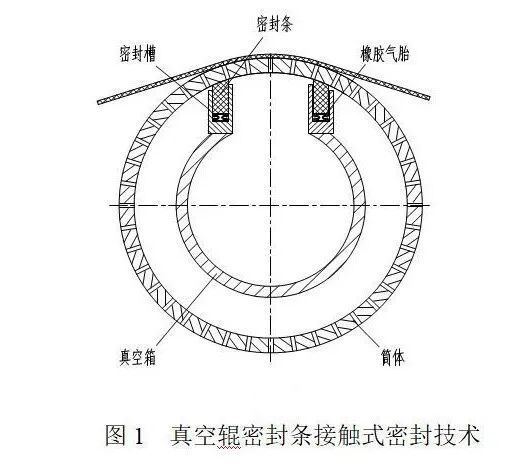
Main existing problems: Seal strips require periodic replacement; high power consumption and noise; seal strips experience “flipping” phenomenon; occurrence of “tire burst” phenomenon.
2. Non-Contact Sealing Technology for Vacuum Roll Seal Strips
To reduce the power consumption and operational noise of vacuum rolls and extend the service life of seal strips as much as possible, a foreign paper machinery equipment company invented a “Non-Contact Sealing Technology for Vacuum Roll Seal Strips.” The basic principle of this technology: There is one airbag each below and on the side of the seal strip.
The airbag below the seal strip can be called the “pressurizing airbag,” and the airbag on the side is called the “locking airbag.” During operation, the “pressurizing airbag” is first inflated to make the seal strip contact the inner wall of the roll.
Then, the “locking airbag” is inflated while the “pressurizing airbag” is depressurized. Through a special design, the seal strip slightly retracts and locks in position, creating a tiny gap between the seal strip and the inner wall of the roll.
This ensures the vacuum level of the vacuum box while avoiding wear on the seal strip. Due to vibration, after a period of use, the seal strip may descend, increasing the gap between the strip and the shell, which affects and reduces the vacuum level of the vacuum box.
At this point, an automatic detection and control system activates the “pressurizing airbag” and “locking airbag” again to restore the gap between the seal strip and the inner wall to the set state. This cycle repeats to ensure the sealing performance of the strip.
This technology can significantly extend the life of the seal strip and greatly reduce power consumption and operational noise. However, its structure is complex, and the frequent raising and lowering of the seal strip can still cause wear, necessitating periodic replacement.
3. Critical Contact Sealing Technology for Vacuum Roll Seal Strips
As shown in Figure 2, its structure mainly consists of a seal groove, seal strips, and a rubber airbag. Both the seal strip and the rubber airbag are installed within the seal groove.
The seal strip is placed on top of the rubber airbag, with its upper part contacting the inner wall of the roll shell. The rubber airbag is located at the bottom of the seal groove.
The heights of the two side openings of the seal groove are different. Bosses are machined on the middle inner walls of both sides of the left seal groove and on the upper inner walls of both sides of the right seal groove. Corresponding grooves are machined on the seal strip.
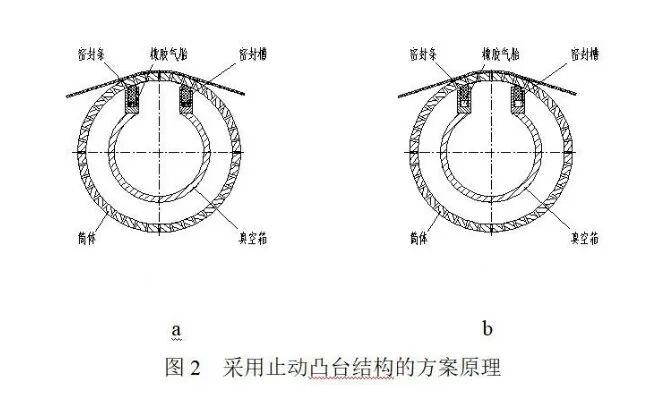
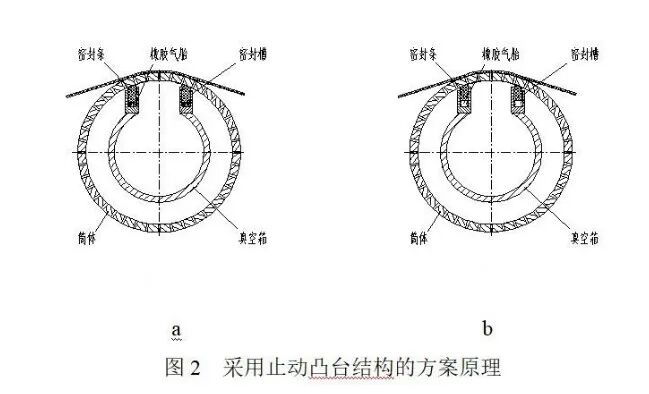
Figure 2a shows the structure when the seal strip is first installed. There is still a distance between the side groove of the seal strip and the lower part of the boss on the side wall of the seal groove.
Under the action of the rubber airbag, the seal strip presses against the inner wall of the shell, gradually wearing and moving upward until the condition shown in Figure 2b is reached.
The lower part of the seal strip’s side groove contacts the lower part of the boss on the side wall of the seal groove. Blocked by the boss, the seal strip can no longer move further. A critical contact state is achieved between the seal strip and the inner wall of the shell, and the seal strip ceases to wear further.
At this stage, because the seal strip and the inner wall are in critical contact, sealing is ensured while friction between them is minimal or non-existent. Consequently, power consumption caused by friction between the seal strip and the inner wall is significantly reduced.
The seal strip can be used permanently without periodic replacement; sealing effectiveness is good with low power consumption and noise; the “tire burst” phenomenon does not occur; consumption of lubricating water for the seal strip is reduced; the structure is simple and cost-effective.
4. Application Results
Using the aforementioned technology, we retrofitted the vacuum rolls on a customer’s Fourdrinier multi-cylinder cultural paper production line. After nearly two years of operation, the comparative results are as follows:
(1) Paper Machine Specifications: Trim width 3750 mm, operating speed 800 m/min, basis weight range 40–80 g/m². Retrofitted rolls: Vacuum couch roll, vacuum pickup roll, vacuum press roll.
(2) Total Annual Maintenance Frequency and Main Content per Roll: Before retrofit: Seal strip and airbag replacement 10–15 times/year. After retrofit: Inspection, cleaning, maintenance 3 times/year.
(3) Downtime Loss Due to Roll Maintenance: Before retrofit: 60–90 hours; After retrofit: 12 hours.
(4) Roll Maintenance Costs (excluding labor): Before retrofit: 150,000 – 250,000 CNY; After retrofit: 10,000 – 20,000 CNY.
(5) Power Consumption Before and After Retrofit: Power savings of 100–150 kW/h, equivalent to 500,000 – 800,000 CNY/year (electricity price calculated at 0.60 CNY/kWh).
(6) Fresh Water Usage Before and After Retrofit: Before retrofit: 200,000 – 3,000,000 m³/year; After retrofit: 100,000 – 1,500,000 m³/year, saving water costs of 150,000 – 250,000 CNY (water price calculated at 2.0 CNY/m³).
(7) Noise Level After Retrofit: Before retrofit, noise near vacuum rolls was around 95 dBa; after retrofit, around 90 dBa, improving the working environment for operators.
Based on the above data, excluding labor costs and saved downtime, the direct annual economic benefits generated or saved from retrofitting the paper machine’s vacuum rolls with critical contact sealing amount to 800,000 – 1,200,000 CNY.